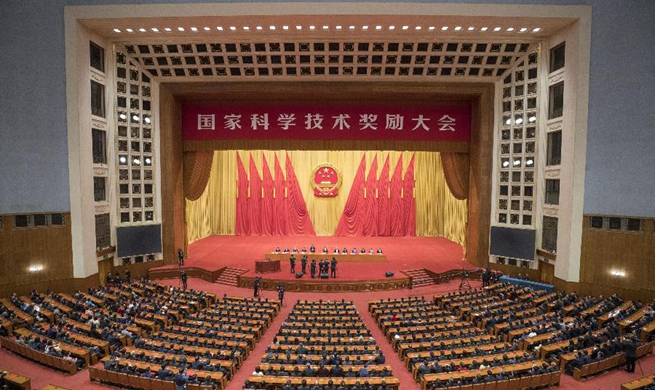
BEIJING, Jan. 8 (Xinhua) -- Hou Yunde, a scientist who dedicated himself to antiviral research, won China's top science award Monday for his contribution in the field.
Hou, born in 1929 in east China's Jiangsu Province, is an academician of the Chinese Academy of Engineering and also a researcher of the National Institute for Viral Disease Control and Prevention (NIVDCP) with the Chinese Center for Disease Control and Prevention.
From 1958 to 1962, he went to the Soviet Union to study medical science. During those years, he published 17 academic papers and earned a PhD in medical sciences from the higher education ministry of the Soviet Union for his academic excellence.
Hou's diligence was admired by his colleagues. Wu Guizhen, Party chief of the NIVDCP, said that his book "Molecular Virology" was regarded as the "bible" in virology.
Hou continues to translate and edit cutting-edge academic work and has so far compiled more than 500 professional books, Wu added.
In the early 1990s, Hou started China's first genetic engineering drug company in a basement.
"Once, Hou opened his drawer showing his papers and told me about his hopes for scientific results to become medicine that can help Chinese people," said Cheng Yongqing, who co-founded the business with Hou.
As one of China's top scientists in biotechnology, Hou's teams have developed recombinant human interferon, alpha 1b, which has been key in new drug research and development and the industrialization of China's genetic engineering project.
Interferons are a group of signaling proteins that act as antiviral agents. In the 1980s, China depended entirely on imported interferons, but now the majority of interferons in China can be produced domestically.
"Alpha 1b has few side effects and will not cause high fevers," said Hou. "I expect that it will replace similar foreign products in the international market in the future."
Due to the efforts by Hou and other medical workers, China has set up an infectious disease detection system, effective within 72 hours, that can identify about 300 known pathogens and test unknown pathogens, including the H1N1 influenza virus, the H7N9 bird flu virus, Ebola virus, and the Middle East Respiratory Syndrome (MERS) virus.