



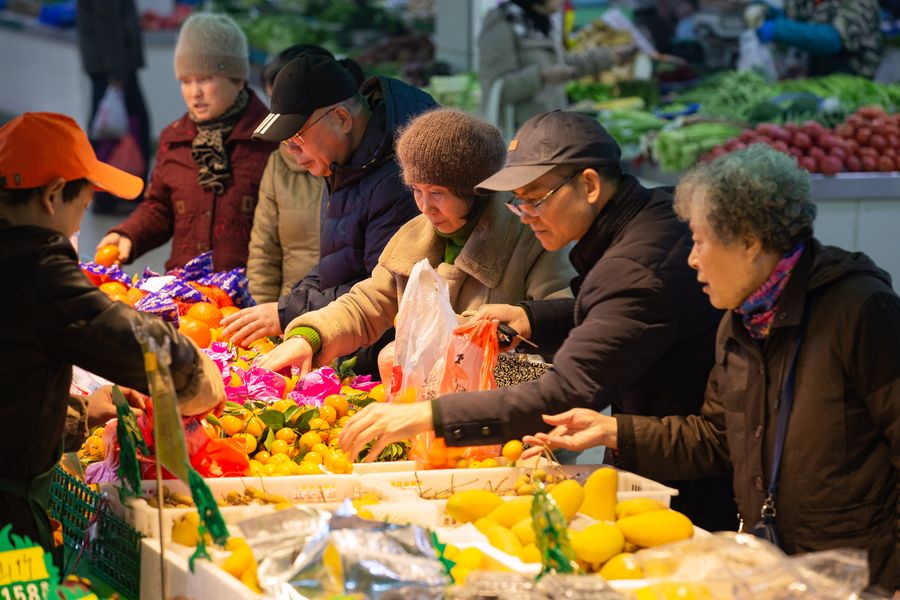
People buy fruit at a market in Nanjing, capital of east China's Jiangsu Province, March 9, 2019. (Xinhua/Su Yang)
The latest data showed that the country was able to achieve the dual mandate of keeping both inflation and growth stable.
BEIJING, Jan. 9 (Xinhua) -- In the Year of the Pig, policymakers in China are faced with a dilemma: how to contain soaring pork prices while shoring up the economy?
In the past year, rising pork prices have driven up consumer inflation, hinting at tightened monetary policies. In the meantime, external uncertainties have dampened growth prospects, calling for more easing measures.
The latest data showed that the country was able to achieve the dual mandate of keeping both inflation and growth stable.
The consumer price index (CPI), a main gauge of inflation, rose 2.9 percent year on year in 2019, within the government target of 3 percent, data from the National Bureau of Statistics (NBS) showed Thursday.
In December, the CPI climbed 4.5 percent year on year, unchanged from that in November and weaker than market consensus of 4.7 percent.
The stabilization of CPI growth was mainly due to falling price inflation for pork and eggs, which offset higher vegetable and non-food price inflation, said Lu Ting, chief China economist with Nomura, in a research note.
Pork prices surged 97 percent year on year in December, slowing from the 110.2-percent growth seen in November. Prices for other kinds of protein including beef, mutton and poultry saw slower growth last month, data from the bureau showed.
The retreat in pork prices came as government measures at national and local levels to restore hog production started to take effect.
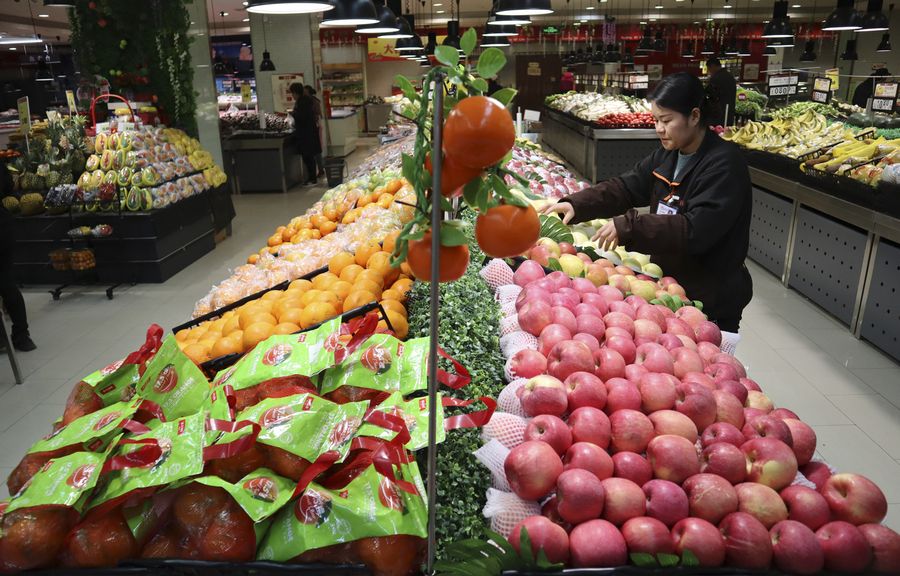
A saleswoman arranges fruit at a supermarket in Handan, north China's Hebei Province, March 9, 2019. (Xinhua/Wang Jiuzhong)
Instead of opting for monetary tightening to contain rising pork prices, policymakers have resorted to more targeted measures, incentivizing hog production via subsidies and releasing pork reserves to the market to increase supply.
A State Council executive meeting Wednesday called for more efforts to ensure supply during the upcoming Chinese Lunar New Year when demand for the staple meat usually peaks.
While food prices retreated, a pick-up in non-food prices and a rebound in producer prices showed resilience in the economy as pro-growth measures stabilized market expectations, analysts said.
Non-food prices gained 1.3 percent last month, faster than the 1-percent growth in November, while the producer price index (PPI), measuring costs for goods at the factory gate, dropped 0.5 percent year on year in December, narrowing from the 1.4-percent decline in November.
A rebound in PPI usually indicates improved market demand and a recovery in confidence of industrial enterprises.
In line with the firming PPI, previous NBS data showed that profits of China's major industrial firms rose 5.4 percent year on year in November, reversing from the 9.9-percent decline in October.
China has been fine-tuning policies and stepping up precise stimulus to shore up growth, injecting funds into the market through monetary tools such as medium-term lending facility (MLF) and targeted MLF (TMLF).
The central bank is expected to roll over its maturing MLF and TMLF in the coming months, Lu said, expecting more monetary easing when inflation pressure declines. ■
