




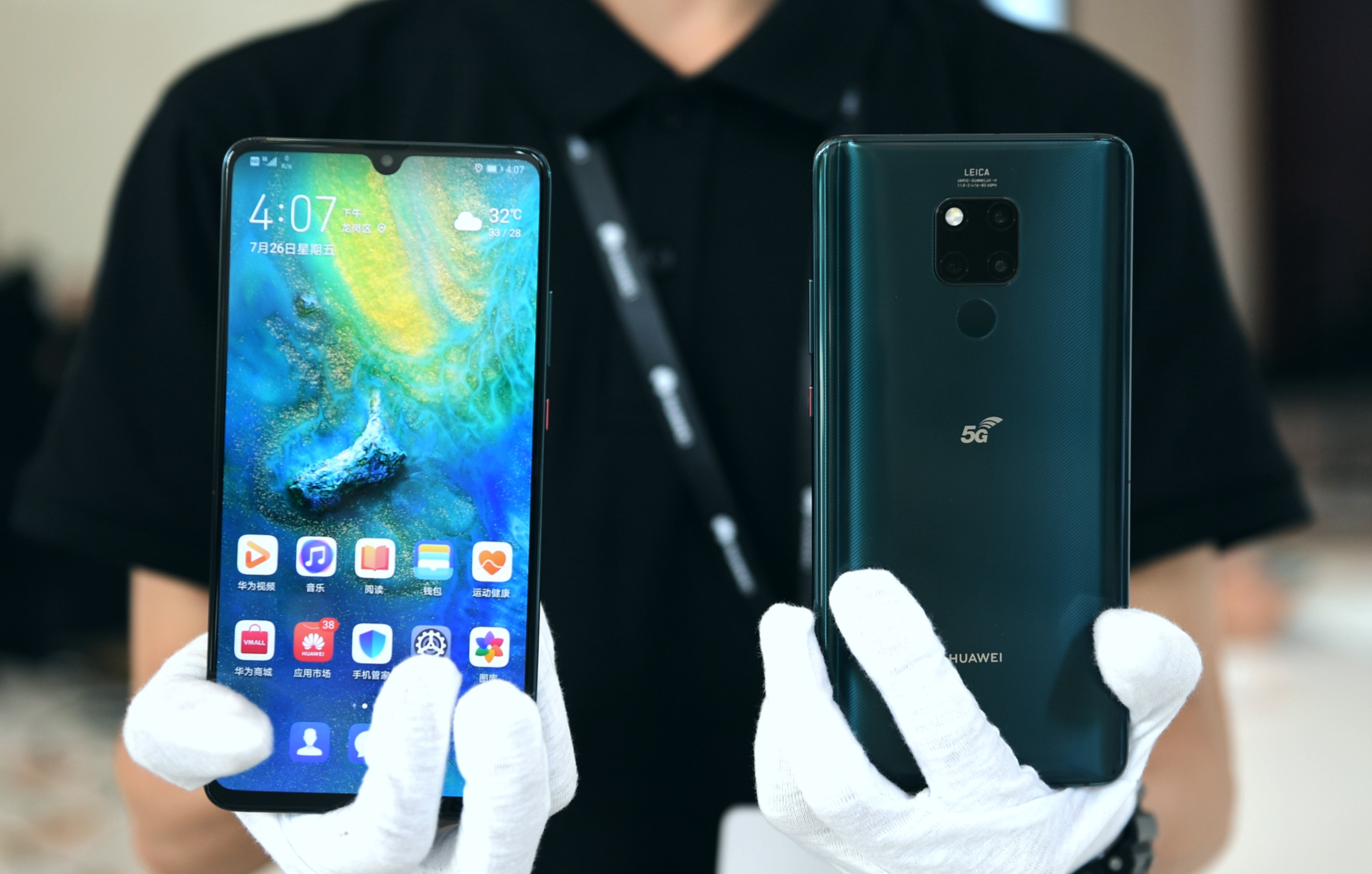
A staff member presents Huawei Mate 20 X (5G) mobile phone at the launching ceremony in Shenzhen, south China's Guangdong Province, July 26, 2019. The smartphone, powered by the Balong 5000, Huawei's first 7nm multi-code 5G chipset with the Kirin 980, is currently the world's only dual-mode 5G cellphone that supports standalone/non-standalone (SA/NSA) simultaneously. (Xinhua/Mao Siqian)
The U.S. government on Wednesday issued an interim regulation, prohibiting its federal agencies from purchasing telecommunications equipment and services from five Chinese companies, including Huawei. The company said it will continue challenging constitutionality of U.S. ban.
SHENZHEN, Aug. 8 (Xinhua) -- China's tech giant Huawei said Thursday it will continue to challenge the constitutionality of the latest U.S. ban on agencies from purchasing the company's telecom gears.
The U.S. government on Wednesday issued an interim regulation, prohibiting its federal agencies from purchasing telecommunications equipment and services from five Chinese companies, including Huawei, according to an official website run by General Services Administration, the U.S. government agency responsible for contracting.
In a media statement, the Shenzhen-based company called the action "not unexpected" as it is the continued promulgation of the rules laid out by the National Defense Administration Act (NDAA) of 2019.
The NDAA, signed by President Donald Trump last year, included a ban on U.S. government agencies and those receiving federal grants and loans from doing business with Huawei and companies substantially using Huawei products.
"The NDAA law and its implementing provisions will do nothing to ensure the protection of U.S. telecom networks and systems and rather is a trade barrier based on country-of-origin," the company said.
Huawei said it will continue to challenge the constitutionality of the ban in the U.S. federal court.
"Ultimately, it will be rural citizens across the U.S. that will be most negatively impacted as the networks they use for digital connectivity rely on Huawei," the company said.
On May 27, Song Liuping, Huawei's chief legal officer, wrote in an opinion article in the Wall Street Journal that Huawei had sued and would file a motion for summary judgment asking a U.S. court to declare the NDAA law unconstitutional.
