
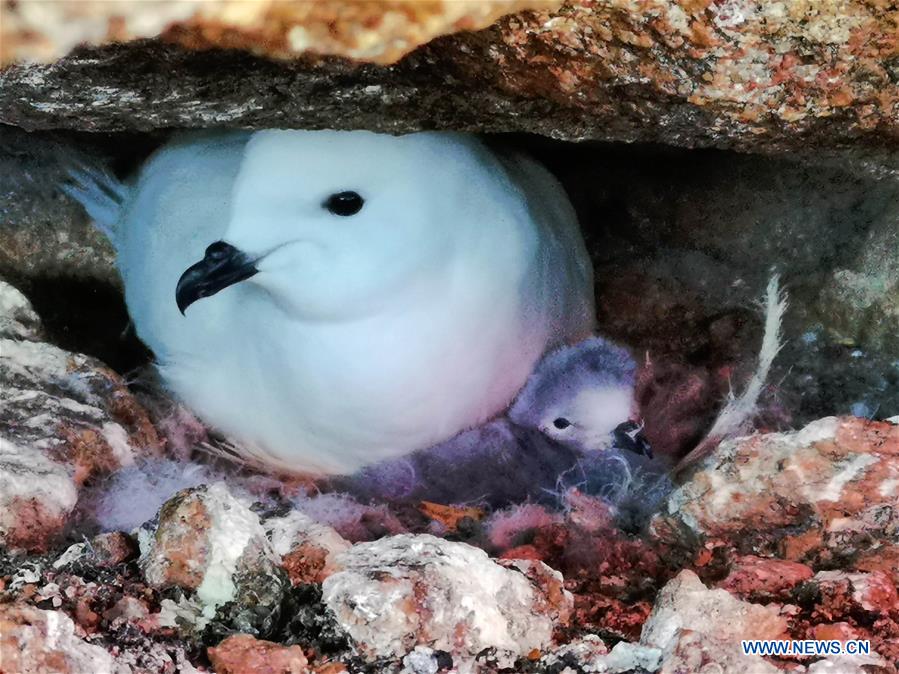
A snow petrel and its chick are seen near the Zhongshan Station, a Chinese research base in Antarctica, Jan. 14, 2019. Chinese researchers have begun using infrared cameras to monitor Antarctica's snow petrel, a key indicator species of the local marine ecosystem. This is the first time Chinese researchers in Antarctica have used infrared cameras in bird monitoring. (Xinhua/Liu Shiping)
ANTARCTICA, Feb. 13 (Xinhua) -- Chinese researchers have begun using infrared cameras to monitor Antarctica's snow petrel, a key indicator species of the local marine ecosystem.
"It's an advanced method to use infrared cameras in monitoring wild animals, and the camera's use has enabled automatic monitoring on the bird's life in the area of Zhongshan Station," said Zhang Zhengwang, a professor from Beijing Normal University and a member on China's 35th research mission in Antarctica.
"This is the first time Chinese researchers in Antarctica have used infrared cameras in bird monitoring, " he added.
With the help of a total of 11 infrared cameras, Zhang has conducted the first systematic investigation and monitoring of the snow petrels living around the Chinese research base for more than two months.
Zhang said he continuously monitors the reproductive behavior of 109 of the some 470 snow petrel families he observed and put on record, and found that they brooded mostly during the night.
In addition, the Chinese researcher listed natural predators, extreme weathers and human activities as the major factors affecting the reproduction and population of Antarctica's birds, and urged further efforts to protect the local ecosystem.
The snow petrel is one of only three birds that breed exclusively in Antarctica. It builds nests in the crevices of the rocks of cliffs, lays eggs between late November and early December, and has a breeding time of 90 to 100 days.