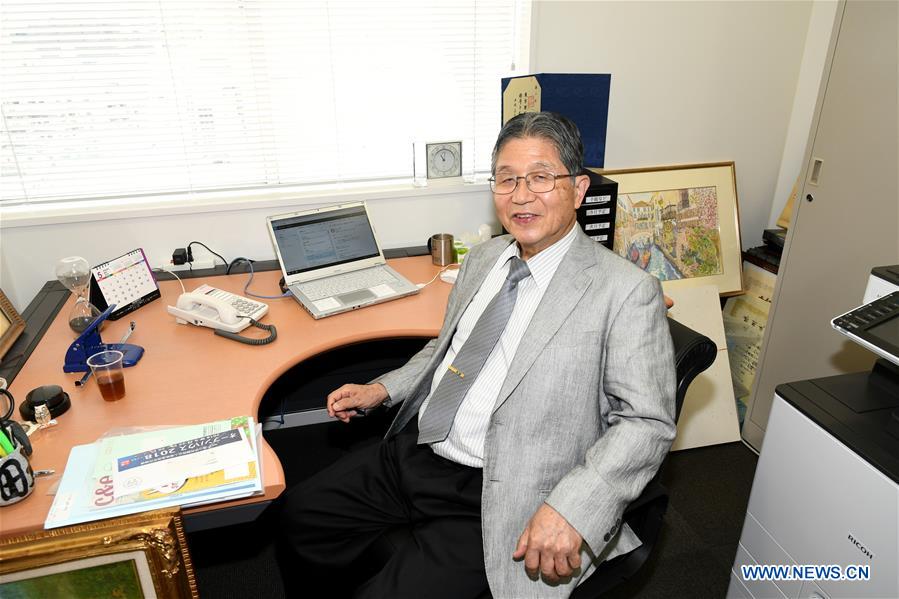
Akira Fujishima, famous Japanese chemist and former president of Tokyo University of Science, works in his office in Tokyo, Japan, on May 29, 2018. (Xinhua/Hua Yi)
TOKYO, June 2 (Xinhua) -- "Confucius once said: One with understanding is not as good as one with interest, which in turn is not as good as doing something one enjoys ... There are countless (such) Chinese sayings that convey to us the truth about life," said Akira Fujishima, famous Japanese chemist and former president of Tokyo University of Science.
Fujishima, 76, admires the ideas of ancient Chinese sages and believes that they are also instructive for modern scientific researchers.
Although he does not speak the Chinese language, he has been studying Chinese classics such as the Japanese version of The Analects of Confucius, and has co-authored a few books to convey the Chinese inspirations to science students in Japan.
Fujishima's own experience and passion for scientific research are also an embodiment of the above-mentioned motto from Confucius (551-479 BC), an educator, philosopher and founder of Confucianism.
In 1967, while working on his Ph.D. under the supervision of professor Kenichi Honda, Fujishima discovered the phenomenon of photocatalytic water decomposition when he exposed a titanium dioxide electrode to strong light, later called the Honda-Fujishima effect.
Fujishima became a professor at the University of Tokyo, and was appointed executive director of the Chemical Society of Japan in 1989. He became the president of Tokyo University of Science in 2010.
Over the past 40 years, Fujishima has trained a total of some 38 Chinese students, many of whom are now the backbone of Chinese universities and scientific research institutions, and three are members of the Chinese Academy of Sciences.
"My Chinese students are very excellent and they have worked hard. Being elected Academicians of the Chinese Academy of Sciences is one of the highest honors of the Chinese science and technology community. I'm really proud of them," said Fujishima.
Fujishima was also impressed by China's fast development over the past 40 years, including the development in science and technology.
"I have been to China hundreds of times ... When I first went to Beijing about 40 years ago, you could see people riding bicycles and horse carriages carrying goods on the street. Now it's a different scene," he recalled.
He added that China has also made a lot of progress in scientific research, as the Chinese government attaches great importance to it and maintains a long-term and stable research policy.
A few Chinese students of Fujishima published a book recently about how they were inspired and helped by the professor, both in their careers and in daily life.
"Professor Fujishima's passion for science has been an inspiration to me. He has a high academic demand for his students, but meanwhile gives his students a lot of freedom and autonomy," said Liu Zhongfan, a member of the Chinese Academy of Sciences.
"He also cares much about his students, sparing no efforts to help them in their careers. I learned a lot from him."
In March, Fujishima retired from the presidency of Tokyo University of Science, but he continued to engage in scientific research while working as "honorary advisor" of the university.
"I haven't set the time for retirement from scientific researches. I will continue to engage in researches as long as I can," he said.