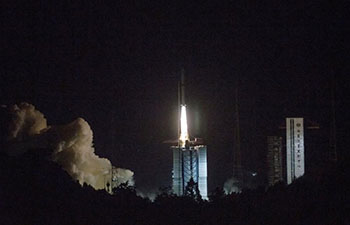
LOS ANGELES, May 22 (Xinhua) -- U.S. private space firm SpaceX launched two new Earth-observing satellites for NASA and five commercial communications satellites for Iridium on a used Falcon 9 rocket in a ride-share mission on Tuesday.
The unique rideshare mission blasted off from Space Launch Complex 4E (SLC-4E) at Vandenberg Air Force Base, the state of California, at 12:47 p.m. PDT (1947 GMT).
This Iridium-6/GRACE-FO Mission first deployed the Gravity Recovery and Climate Experiment Follow-On (GRACE-FO) satellites approximately 11 minutes and 30 seconds after launch.
"The twin #GRACEFO satellites have deployed from the @SpaceX Falcon 9 rocket. We await our first communication from #GRACEFO via our communications station at McMurdo, Antarctica," NASA tweeted after launch.
The joint project between the U.S. National Aeronautics and Space Administration (NASA) and the GFZ German Research Center for Geosciences (GFZ) GRACE-FO mission will continue GRACE's 15-year legacy of tracking the movement of Earth's mass. As its twin satellites fly over areas of higher and lower mass, the distance between them changes slightly due to gravitational forces.
The GRACE-FO mission is expected to last at least five years, but requires both satellites in healthy condition to collect useful data, according to NASA.
Tuesday's launch also carried to orbit five more satellites for Iridium Communications' second-generation Iridium-NEXT constellation, joining 50 such spacecraft already in operation.
"Successful deployment of 5 @IridiumComm NEXT satellites to low-Earth orbit confirmed," SpaceX confirmed after about one hour and 12 minutes after the liftoff.
The Iridium Next communications satellites that SpaceX is launching with GRACE-FO are the latest in a series for Iridium Communications to build up that company's satellite constellation.
A total of eight Iridium NEXT launches are planned with SpaceX, which will deliver 75 new satellites to orbit. In total, 81 satellites are being built, with 66 in the operational constellation, nine serving as on-orbit spares and six as ground spares.
Last year, Iridium and the GFZ, who are responsible for arranging GRACE's ride to orbit, agreed to share a launch on SpaceX's Falcon 9 rocket, splitting the costs while allowing the GRACE mission to continue and Iridium to get further satellites into orbit.
"In 2016, there was a commercial launch that actually put government rideshare on it, so we are seeing more options that commercial satellites can put government rideshare on it," Carrie O'Quinn, Senior Project Engineer at the Aerospace Corporation, told Xinhua.
"I would like to see more of it, just because I'd like to see the total launch cost to go down...you know...get us to space as fast as we can," she said.
Falcon 9's first stage for the Iridium-6/GRACE-FO mission previously launched the U.S. Air Force's classified Zuma mission in January. That mission was lost, but SpaceX was not to blame for the mishap.
Although the rocket stuck a flawless landing on its last mission, the California-based company does not plan to attempt to recover Falcon 9' s first stage after launch.
However, SpaceX did attempt to recover the valuable payload fairing, or nose cone, that covered the GRACE-FO and Iridium satellites during launch.
At least one of the fairing halves was expected to glide back to Earth under a parafoil and be caught by Mr. Steven, a recovery boat equipped with a huge net suspended between giant metal arms.
"We came very close. We're going to keep working on that," John Insprucker, a principal integration engineer at SpaceX, said during a live webcast of Tuesday's mission.