
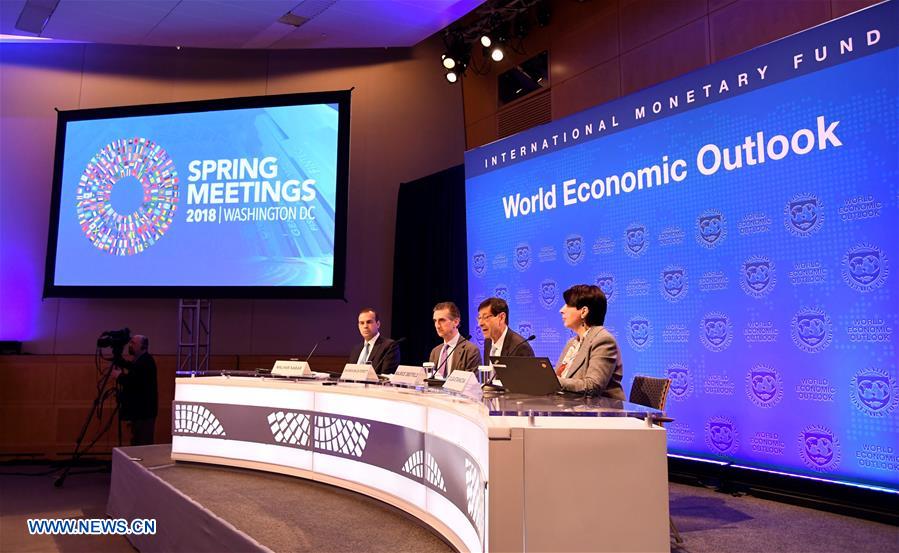
Maurice Obstfeld (2nd R), Economic Counsellor and Director of Research at the International Monetary Fund (IMF), speaks on the newly-released World Economic Outlook in Washington D.C., the United States, April 17, 2018. The International Monetary Fund on Tuesday kept its growth forecasts for the world economy unchanged for this year and next year, but warned that a potential broad-based trade conflict threatens to derail global growth prematurely. (Xinhua/Yang Chenglin)
WASHINGTON, April 17 (Xinhua) -- The International Monetary Fund (IMF) on Tuesday kept its growth forecasts for the world economy unchanged for this year and next year, but warned that a potential broad-based trade conflict threatens to derail global growth prematurely.
In its newly-released World Economic Outlook, the IMF said the global economy would grow 3.9 percent in 2018 and 2019, unchanged from its previous forecast in January.
The global recovery is supported by "strong momentum, favorable market sentiment, accommodative financial conditions, and the domestic and international repercussions of expansionary fiscal policy in the United States," the IMF said.
Maurice Obstfeld, economic counsellor and director of research at the IMF, said that the world economy continues to show broad-based momentum, but the prospect of a similarly broad-based conflict over trade presents a jarring picture.
"The prospect of trade restrictions and counter-restrictions threatens to undermine confidence and derail global growth prematurely," Obstfeld said at a press conference Tuesday.
"That major economies are flirting with trade war at a time widespread economic expansion may seem paradoxical -- especially when the expansion is so reliant on investment and trade," he said.
Obstfeld called for "dependable and fair dispute resolution" within a strong rule-based multilateral framework to address intellectual property concerns and other "inequitable trade practices."
"There is room to strengthen the current system rather than risk bilateral fragmentation of international trade," he said, adding that multilateral cooperation remains essential to addressing a range of challenges, including climate change, infectious diseases, cyber-security, and the governance of world trade.
"Global interdependence will only continue to grow and unless countries face it in a spirit of collaboration, not conflict, the world economy cannot prosper," he said.
While the United States has engaged in several bilateral negotiations to reduce U.S. trade deficits with individual trading partners, Obstfeld believed these initiatives will do little to change the overall U.S. external current account deficit.
The overall U.S. external current account deficit "owes primarily to a level of aggregate U.S. spending that continues to exceed total income," he said, adding that the recent U.S. tax-cut package and increased government spending will "actually widen" the U.S. current account deficit.
"Compared with our October 2017 projection, which preceded the recent U.S. tax and spending changes, we now expect the United States' current account deficit for 2019 to be roughly 150 billion dollars higher," he said.