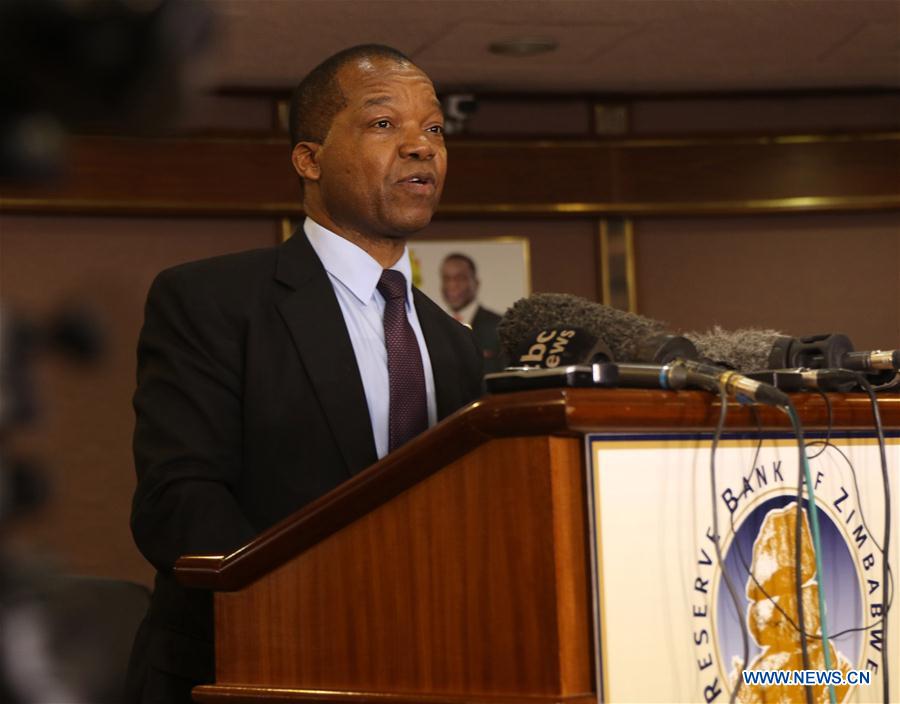
Zimbabwe's central bank governor John Mangudya presents the 2018 National Monetary Policy Statement in Harare, Zimbabwe, Feb. 7, 2018. John Mangudya on Wednesday presented his first post-Mugabe monetary policy statement, warning the nation not to expect an overnight change in economic fortunes. (Xinhua/Shawn Jusa)
HARARE, Feb. 7 (Xinhua) -- Zimbabwe's central bank governor on Wednesday presented his first post-Mugabe monetary policy statement, warning the nation not to expect an overnight change in economic fortunes.
Zimbabwe's former president Robert Mugabe resigned in November last year after 37 years in power, paving way for a new government led by President Emmerson Mnangagwa.
Governor John Mangudya said more work was required to grow the economy through opening up for business, increasing export production and intensifying foreign investment attraction.
He said the country would continue to use the multiple currency regime introduced in 2009 until economic fundamentals are right for reintroduction of a local currency.
Meanwhile, the central bank was negotiating a 1.5-billion-U.S.-dollar facility with African Export-Import Bank (Afreximbank) to guarantee investors' funds as well as improve liquidity.
The bank was also arranging a 400-million-dollar facility to finance critical imports and allow investors to repatriate funds, the governor said.
He said in 2017, the forex-starved country drew down 1.1 billion dollars from various nostro stabilization facilities, which helped to stabilize the foreign exchange market and sustain importation of critical imports.
A total of 290 million bond notes was also in circulation as of December 2017, the governor said.
"This is the money that is in the market, together with the 1.1 billion dollars that we borrowed. It may not be as liquid as we want but it is liquid enough to sustain the economy going forward," Mangudya said.
The governor said he will give an update on the amount of money that has been brought back into the country by companies and individuals that externalized it when the amnesty expires at the end of the February.
"We are encouraged by the overwhelming response by people who are taking measures to comply. The response has been positive from both individuals and corporates," he said.
Mnangagwa's government in November issued a three-month amnesty to people and companies that illegally stashed funds abroad, demanding repatriation on a "no questions asked" basis.
Mangudya said the central bank will intensify re-engagement with the international community to resolve the external payment arrears to the remaining International Financial Institutions (IFIs) as well as bilateral creditors.
"In this regard, the government will follow the previously agreed process for clearing external payment arrears to international financial institutions, which was endorsed by the IFIs and Bilateral Creditors at a meeting held on the side lines of the Annual Meetings of the IMF and World Bank in Lima, Peru, in October 2015," the governor said.
Zimbabwe owes the World Bank 1.15 billion dollars, 601 million dollars to the African Development Bank and over 3 billion dollars the Paris Club, among other creditors.