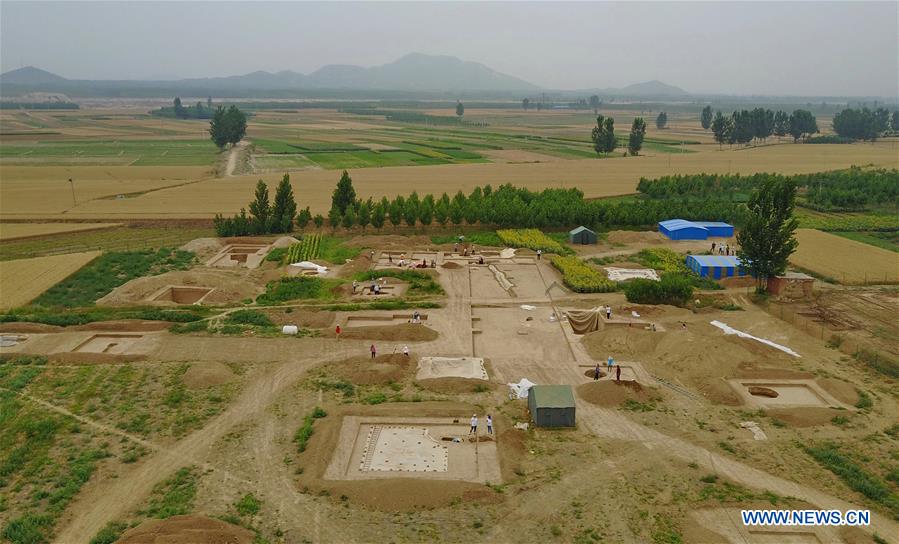
File photo taken on June 12, 2017 shows the archaeological site in Xingtang County, north China's Hebei Province. A wagon team consisting of five chariots and 16 horses was excavated last year from a horse and chariot pit in Xingtang County, revealing the story of the Rong and Di, two major ethnic groups that emerged on what is now Chinese territory. Beside the pit, the relics that dated back from the late Spring and Autumn period (770 B.C.-476 B.C.) to the mid-Warring States period (475 B.C.-221 B.C.) included caves where the heads and hooves of a large number of cattle, sheep and horses were buried in different layers. Bronze utensils and pottery that originated from the central plains where the Huaxia ethnic group stemmed from were also found in the ruins, indicating the integration of the Huaxia culture with the culture of the Rong and Di. The findings in Xingtang site was announced one of the six greatest archeological discoveries of the country in 2017 by the Chinese Academy of Social Sciences. The six findings contain information on human activity over a time span of more than 40,000 years. (Xinhua/Yang Shiyao)
ETHNIC CULTURE REVEALED
A wagon team consisting of five chariots and 16 horses was excavated last year from a horse and chariot pit in Xingtang County, Hebei Province, revealing the story of the Rong and Di, two major ethnic groups that emerged on what is now Chinese territory.
Beside the pit, the relics that dated back from the late Spring and Autumn period (770 B.C.-476 B.C.) to the mid-Warring States period (475 B.C.-221 B.C.) included caves where the heads and hooves of a large number of cattle, sheep and horses were buried in different layers.
Bronze utensils and pottery that originated from the central plains where the Huaxia ethnic group stemmed from were also found in the ruins, indicating the integration of the Huaxia culture with the culture of the Rong and Di.
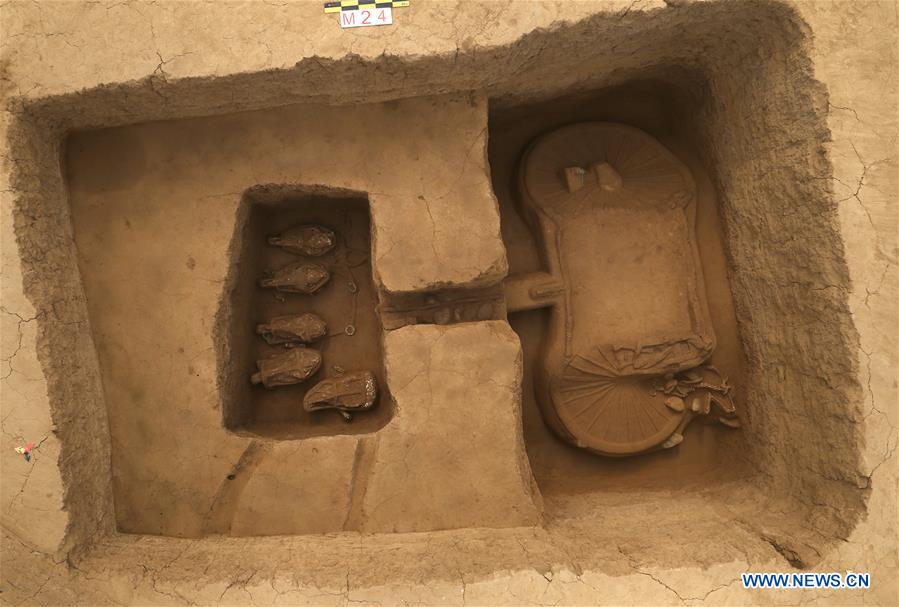
File photo shows a horse and chariot pit in the archaeological site in Xingtang County, north China's Hebei Province. A wagon team consisting of five chariots and 16 horses was excavated last year from a horse and chariot pit in Xingtang County, revealing the story of the Rong and Di, two major ethnic groups that emerged on what is now Chinese territory. Beside the pit, the relics that dated back from the late Spring and Autumn period (770 B.C.-476 B.C.) to the mid-Warring States period (475 B.C.-221 B.C.) included caves where the heads and hooves of a large number of cattle, sheep and horses were buried in different layers. Bronze utensils and pottery that originated from the central plains where the Huaxia ethnic group stemmed from were also found in the ruins, indicating the integration of the Huaxia culture with the culture of the Rong and Di. The findings in Xingtang site was announced one of the six greatest archeological discoveries of the country in 2017 by the Chinese Academy of Social Sciences. The six findings contain information on human activity over a time span of more than 40,000 years. (Xinhua)