
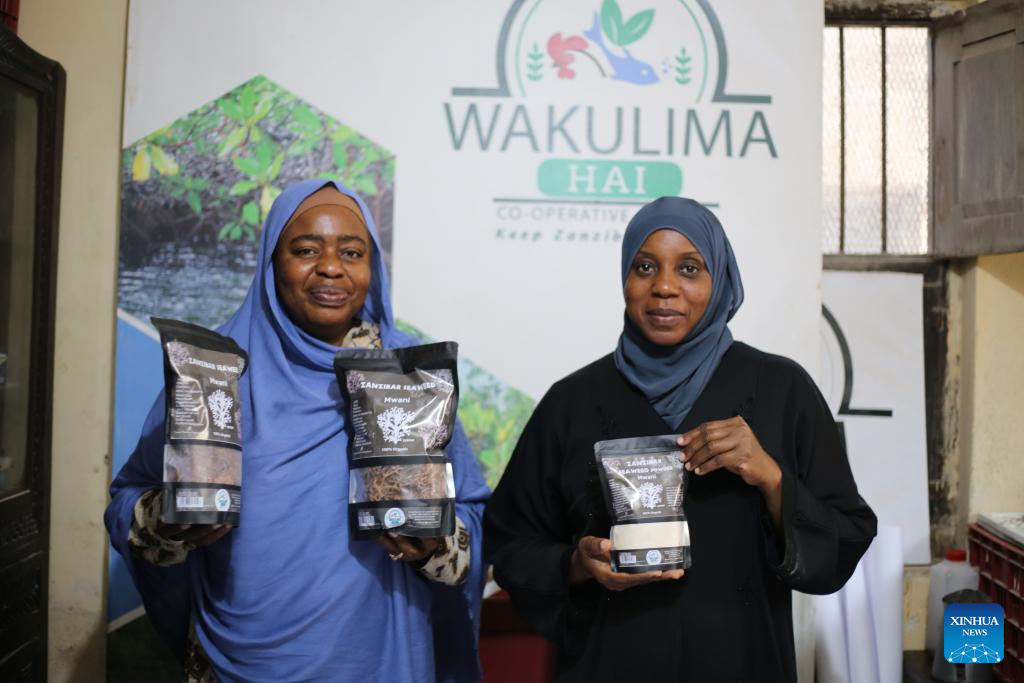
Semeni Mohammed Salum (R), secretary of the Wakulima Hai cooperative society, and a fellow member display seaweed-based products at the cooperative's workshop in Zanzibar, Tanzania, Oct. 4, 2025. (Xinhua/Nurdin Pallangyo)
by Xinhua writers Hua Hongli, Lucas Liganga
DAR ES SALAAM, Oct. 9 (Xinhua) -- In Zanzibar, Tanzania, women are driving the blue economy by turning seaweed and other marine resources into thriving businesses, inspired by China's expertise and cooperation.
Semeni Mohammed Salum, secretary of the Wakulima Hai cooperative society, Swahili for "Living Farmers," is among the pioneers leading this transformation. The cooperative, which brings together more than 100 members, including about 80 women and 20 men from the islands of Unguja and Pemba, has become a model for how women can turn the ocean's bounty into sustainable livelihoods.
"Our cooperative was formed after receiving training from the Ministry of Blue Economy and Fisheries," said Semeni. "We later benefited from entrepreneurship training in China's Fujian Province, where we learned advanced techniques in seaweed and sea cucumber farming."
Semeni's first visit to China in 2011 opened her eyes to new possibilities. At the Fujian Institute of Oceanography, she spent a month learning hands-on skills in marine cultivation. A second visit in 2017 further deepened her expertise in sea cucumber farming and seaweed processing.
"Visiting markets in China, we discovered that many marine products we used to ignore in Zanzibar were highly valued there," she said. "That experience opened our eyes to the vast opportunities around us."
Upon her return, Semeni applied what she had learned and helped establish Zanzibar's first sea cucumber farm. Today, her cooperative not only cultivates seaweed but also processes it into value-added products such as soap, hair oil, massage oil, shampoo, and seaweed powder, alongside selling sea cucumbers, oysters, and fish intestines.
"Initially, we did not know the value of these marine products," Semeni said. "But after training, we realized their potential as food, medicine, and sources of income."
Under her leadership, over 80 percent of Zanzibar's seaweed farmers, most of them women, have benefited from new skills and improved production techniques. According to official statistics, Zanzibar produced 12,594 tonnes of seaweed annually by the end of 2022, with exports reaching nearly 14,000 tonnes per year. The industry now supports about 23,000 farmers, 90 percent of whom are women.
Despite these gains, challenges persist. "Convincing the community to use marine products as food and business is still difficult," Semeni said. "While China and other countries consume them widely, in Tanzania, they are still underutilized."
Semeni believes that the skills and knowledge she gained from China have transformed her life and can uplift many others. "The ocean can empower women economically," she said. "We are grateful to the Chinese government for sharing this knowledge and for showing us that marine resources can transform lives."
For Semeni, the rewards go far beyond financial gains. "Through this business, I have educated my six children. Some are now in universities," she said proudly. "Marine products are not just about income; they are about opportunity, dignity, and a better future." ■
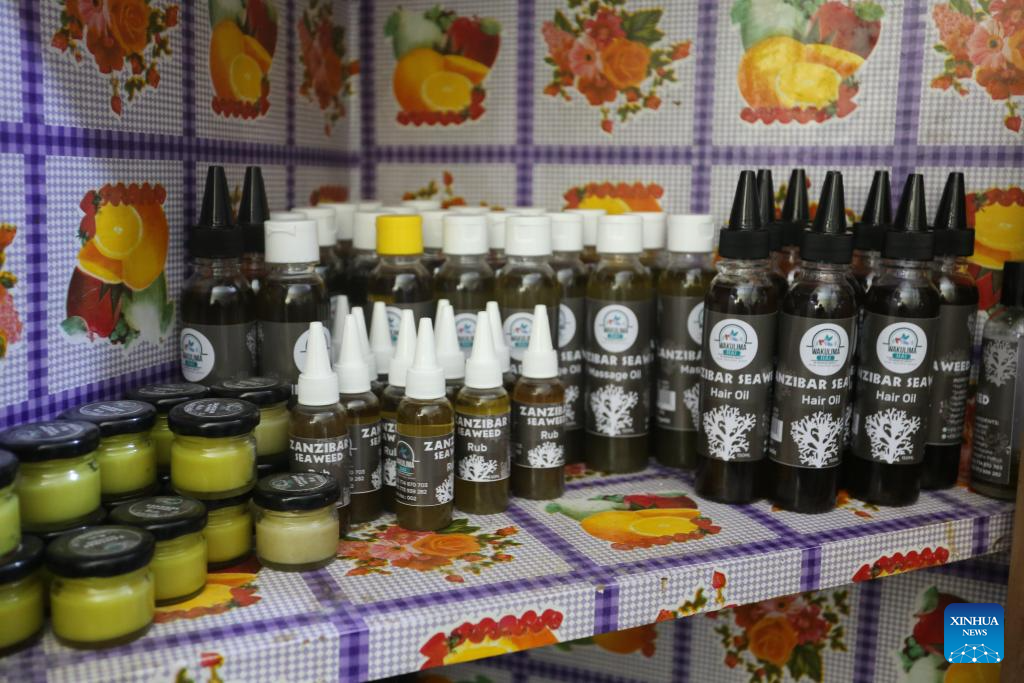
Seaweed-based products including hair oil, massage oil, and balm are seen displayed at the Wakulima Hai cooperative society in Zanzibar, Tanzania, Oct. 4, 2025. (Xinhua/Nurdin Pallangyo)